
They Took Away Your Cash,
Watched Every Paisa You Spent,
Collected Crores in New Taxes —
And Have Now Come for the Change.
The government banned cash, built a surveillance highway out of your payments, collected lakhs of crores in new taxes — and is now billing you for the road.
On August 6, 2026, the Lok Sabha quietly passed the Taxation and Other Laws (Amendment) Bill — on a voice vote, without floor discussion, amid Opposition protests. Buried inside it was a provision that removes the legal bar preventing banks and payment processors from charging merchants for UPI transactions. The era of free UPI, it seems, is being prepared for its end.
The government’s defenders will say this is about sustainability. That the infrastructure costs have to be borne by someone. That NPCI cannot run the world’s largest real-time payments network on goodwill alone.
These are, on their face, reasonable-sounding arguments. They collapse entirely the moment you look at the numbers.
If the government manufactured the problem, profited from the solution, and is now charging you for the pipe it forced you into — what exactly is it governing?
First, They Banned Cash
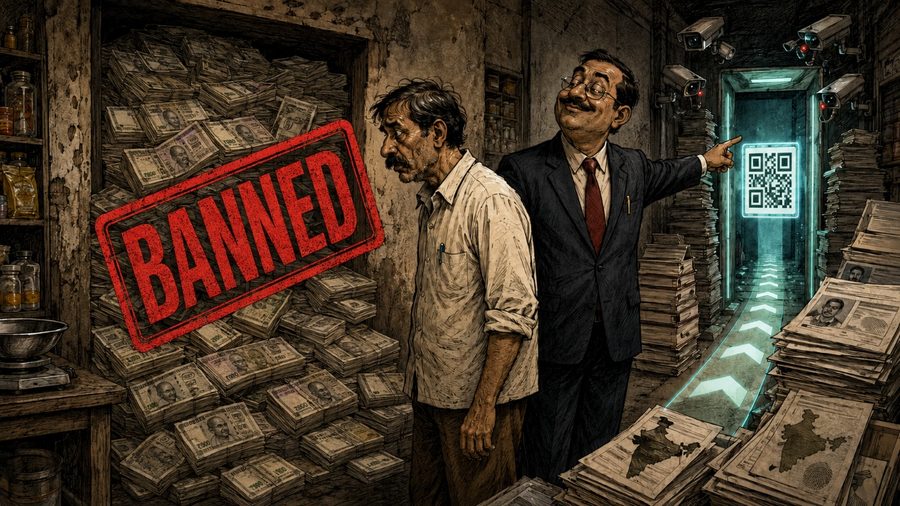
It started with restrictions that were sold as anti-corruption measures. Under Section 269ST of the Income Tax Act, no business can receive more than ₹2 lakh in cash from a single person in a day. Business expense payments above ₹10,000 in cash are disallowed as deductions. Loans above ₹20,000 cannot be taken in cash. The penalties for violation are not token fines — they equal the full amount of cash involved.
The official justification was black money, tax evasion, money laundering. Noble goals, all of them. But notice what the restrictions actually accomplish beyond that: every transaction pushed off cash and onto digital rails becomes permanently visible, permanently searchable, permanently cross-referenceable against your GST filings, your ITR, your TDS obligations.
If the goal was truly to fight black money, why did cash in circulation continue rising — even as UPI exploded to 24,000 crore transactions a year? Who exactly was the restriction aimed at?
Then, They Built a Tollbooth Highway — and Called It a Gift
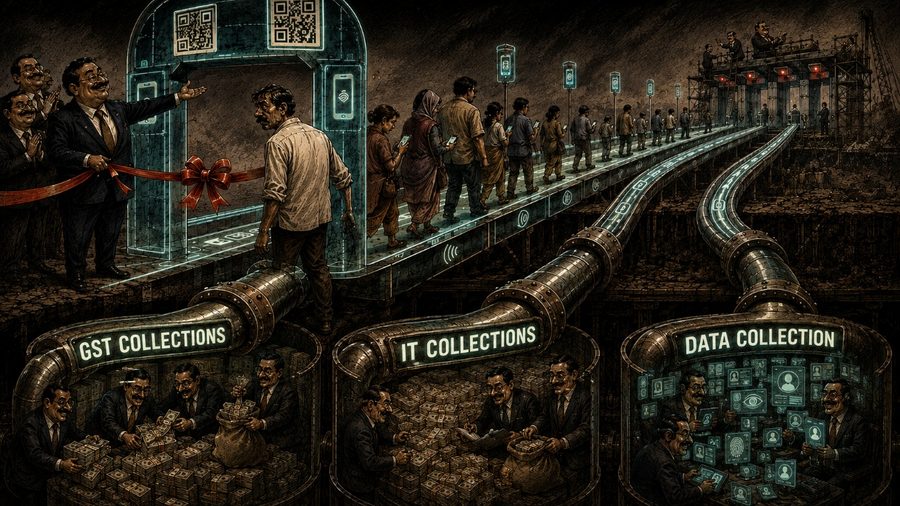
UPI was presented to Indians as a public good. Free, instant, revolutionary. And it is genuinely impressive infrastructure — built by NPCI under RBI oversight, adopted by 700+ banks, processing over ₹314 lakh crore in transactions in FY 2025-26 alone.
What was less advertised: every rupee that moved through UPI instead of cash created a taxable trail the government could mine. GST collections that once relied on self-declaration now had automatic cross-verification. Income that once disappeared into cash transactions was suddenly visible.
THE NUMBERS THE GOVERNMENT WON’T SAY ALOUD
₹680 crore — NPCI’s annual cost to run the entire UPI infrastructure
₹2,300 crore — RBI’s annual savings from reduced cash printing due to UPI
₹1,500 crore — NPCI’s annual profit (EBITDA margins above 50%)
₹12+ lakh crore — Approximate annual increase in GST collections since pre-UPI era
Read those numbers again. The infrastructure costs ₹680 crore to run. The government saves ₹2,300 crore just from printing less cash. NPCI is already profitable at over 50% EBITDA margins. And the additional tax revenue flowing from forced digital transparency runs into lakhs of crores annually — dwarfing the infrastructure cost by a factor of thousands.
When the RBI Governor says ‘costs have to be paid by someone,’ shouldn’t the honest answer be: they already are — several times over?
The Seigniorage Question the Government Isn’t Answering
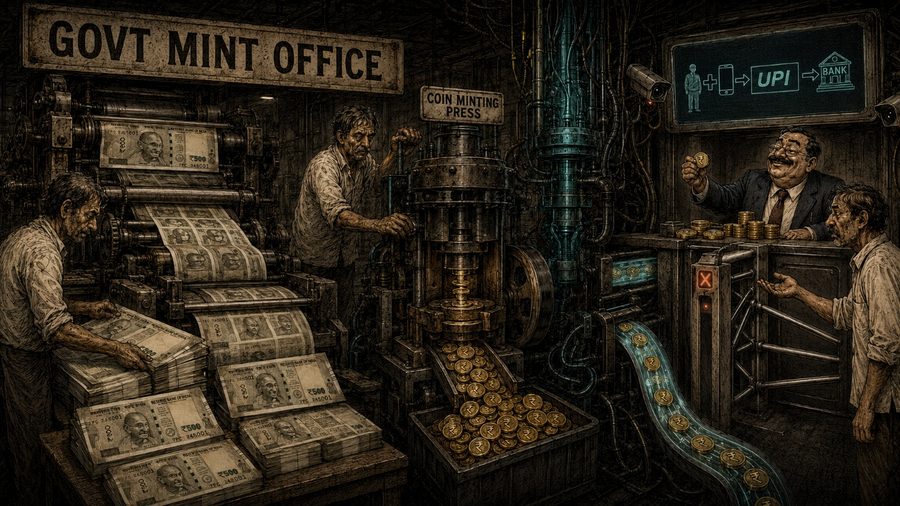
There is a concept in monetary economics called seigniorage — the profit a government makes from issuing currency, essentially the difference between the face value of money and its cost of production. Historically, maintaining the money supply has been understood as a core state obligation, funded through this mechanism and through general taxation. Citizens don’t pay a per-note fee to use cash. The cost of currency is absorbed as a public good.
When the government restricts cash and forces transactions onto digital rails, it is effectively outsourcing its money supply function to private banks and payment processors. The logical consequence of that choice — in any honest accounting — is that the state should bear the cost of that outsourcing from its own revenues. Or it should stop restricting cash.
Citizens already pay GST and income tax precisely so the government performs its basic functions — including maintaining the medium of exchange. At what point does taxation become payment for a service that is then separately billed to you again?
While the Freebies Flow Freely
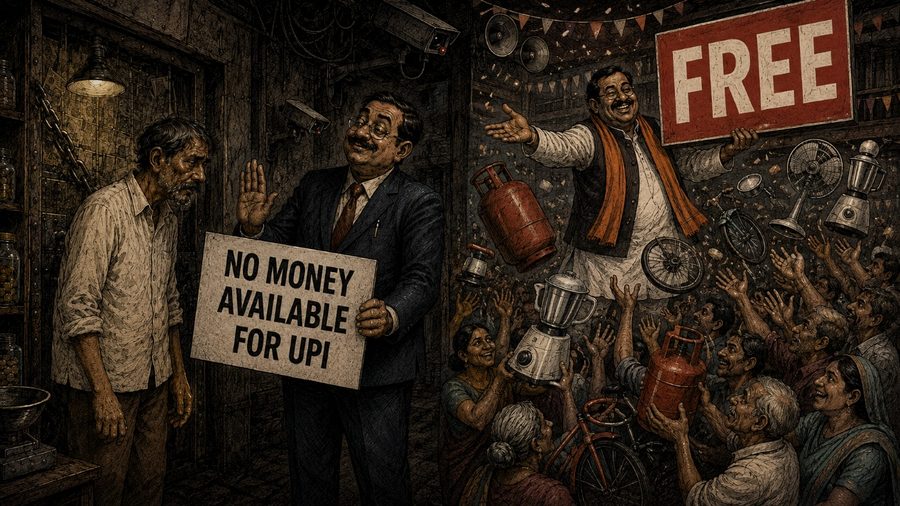
None of this fiscal hand-wringing about UPI sustainability extends to schemes like Ladki Bahin, Ladli Behna, free ration distribution, or the constellation of election-season cash transfers that have become permanent features of the Indian fiscal calendar. Lakhs of crores flow toward these without the government once asking ‘but who will pay for it?’
These schemes are funded from the same Consolidated Fund that receives all that additional GST and income tax flowing from the forced digitisation of the Indian economy. The government is, in plain terms, taking the windfall from making your transactions transparent — and spending it on vote-buying — while simultaneously telling you that the infrastructure that generates that windfall is too expensive to maintain for free.
If the state can find unlimited money for discretionary political schemes, why does it suddenly discover fiscal prudence only when it comes to its own constitutional obligations?
Highway Robbery Dressed Up as Sustainability
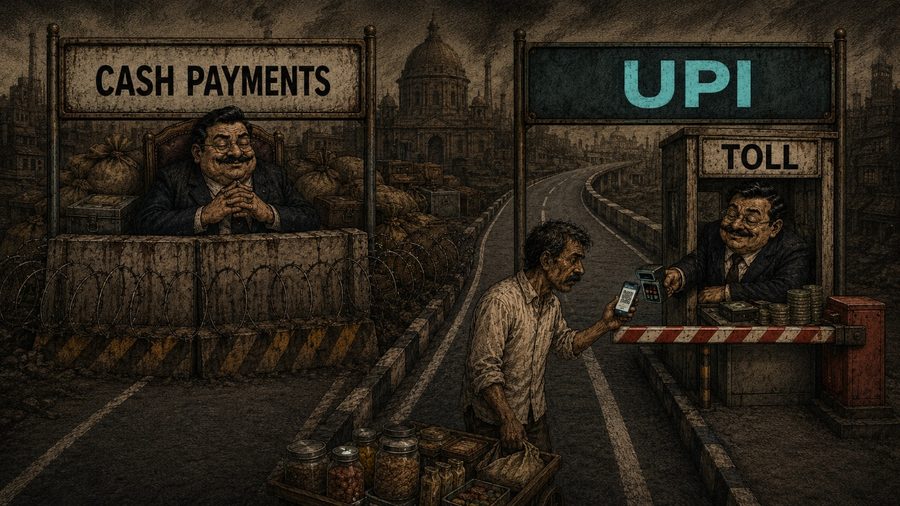
Consider the complete arc of what has happened. The government restricted cash, forcing businesses and consumers onto digital platforms. Those digital platforms generated a massive, permanent audit trail. That audit trail dramatically increased tax collections — lakhs of crores in additional revenue annually. NPCI, running the infrastructure on ₹680 crore a year, turned profitable with 50% margins. The government pocketed the tax windfall and spent it on freebies.
And now, having accomplished all of that, it is opening the door to charging the same merchants — many of them small traders, street vendors, and kirana owners who were explicitly brought onto UPI through financial inclusion drives — a percentage on every transaction they were told would always be free.
Either Give Us Back Cash Freedom or Bear the Cost of UPI
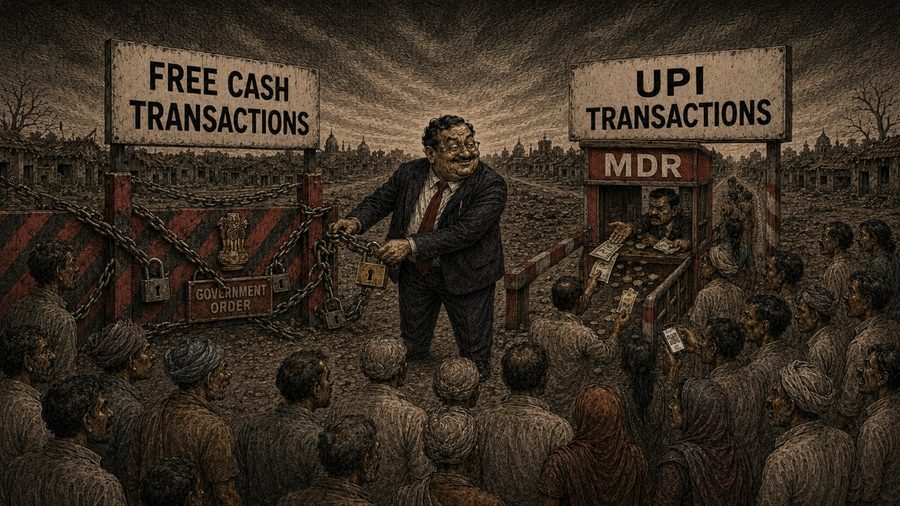
The sustainability argument, stripped of its press release language, reduces to a single claim: someone has to pay for UPI. The government is correct. Someone does. The question it refuses to answer — the one that exposes the entire enterprise — is who that someone already is.
The logic is binary and admits no escape. Either the government funds UPI from the windfall it has already collected — the ₹12 lakh crore in additional GST, the ₹2,300 crore saved on cash printing, the tax revenue it would not have without the digital trail it engineered — or it removes the cash restrictions and returns citizens the freedom to transact without its pipe. One or the other. Maintain the system you made mandatory, or surrender the monopoly you built.
What the government is attempting instead is a third option that does not exist in any honest accounting: keep the cash restrictions, keep the tax windfall, keep the ₹2,300 crore in printing savings — and also charge merchants for the infrastructure that made all of it possible. Collect the rent from the crop, the land, and now the rain.
You cannot ban the well, profit from the pipe, and then bill the thirsty for the water. That is not fiscal policy. That is a toll booth on breathing.
THE BOTTOM LINE:
This is not governance. This is rent-seeking — the use of regulatory power to extract money from citizens rather than to serve them. The infrastructure is profitable. The cash savings more than cover it. The tax windfall dwarfs everything. The MDR bill is not about sustainability. It is about finding one more extraction point on a population that has already been monetised completely, from both ends, with no neutral option remaining.
A government’s core duty is to serve its citizens — to maintain law, defence, and the medium of exchange as public goods. When it restricts the old medium, profits from the new one, taxes the transparency it engineered, and then bills citizens for the infrastructure it made mandatory — it has not governed. It has grifted. At scale. With excellent branding. With the government’s army of bootlickers defending it without shame.