
–How Upper-Caste India Turned Theft Into Principle
The Longest Con in Indian Democracy
How Upper-Caste India Turned Theft Into Principle
The Argument This Essay Does Not Make
Before anything else, let us be clear about what this essay is not arguing.
It is not arguing that reservation compensates for ancient oppression.
It is not asking current generations to pay for what their ancestors did.
It is not a grievance document. It is not a guilt trip. It is not rooted in the past at all.
No civilisation in human history has been free from hierarchy and oppression. Peasant rebellions convulsed Europe for centuries. Feudal violence was the defining feature of the medieval world. Every society, ancient and modern, has its hierarchies — brutal, entrenched, self-perpetuating.
India had caste. The West had feudalism, race, and class. The degree and nature differed. The structural reality of social hierarchy did not.
This essay does not ask you to carry the weight of history. It asks you to look at the present.
Because the argument for reservation does not need history to win. It needs only two things: a definition of democracy, and a look at who actually runs the Indian state today.
Reservation is not compensation for oppression. It is the democratisation of power.
Those are different arguments entirely. The first is about the past. The second is about right now — about whether the permanent machinery of the Indian Republic is legitimate in a democracy, and in whose hands it actually sits.
Everything that follows is about the present tense.
Prologue: The Numbers They Don’t Want You to See
Before a single argument is made, look at the data.
SC, ST, and OBC communities constitute approximately 85% of India’s population.
At entry-level civil service positions, reserved category representation exists — imperfectly, incompletely, but visibly.
At the level of Joint Secretary, it begins to thin. At Additional Secretary, it thins further.
At Secretary and above — the positions that actually run the permanent machinery of the Indian state, that draft policy, control budgets, advise ministers, and exercise the real levers of sovereign authority — upper-caste communities, constituting perhaps 15% of India’s population, occupy over 95% of positions.
Fifteen percent of India. Ninety-five percent of the commanding heights of the permanent state.
This is not a historical injustice. This is today’s distribution of power.
This is the arrangement the anti-reservation movement exists to protect. This is the monopoly it calls merit.
Everything else — every television debate, every newspaper column, every social media rant about examination scores and efficiency and deserving candidates — is noise designed to ensure you never look at these numbers and ask the only question that matters:
In what sense is this a democracy?
Part One: The State Is Not an Employer. It Is a Sovereign.
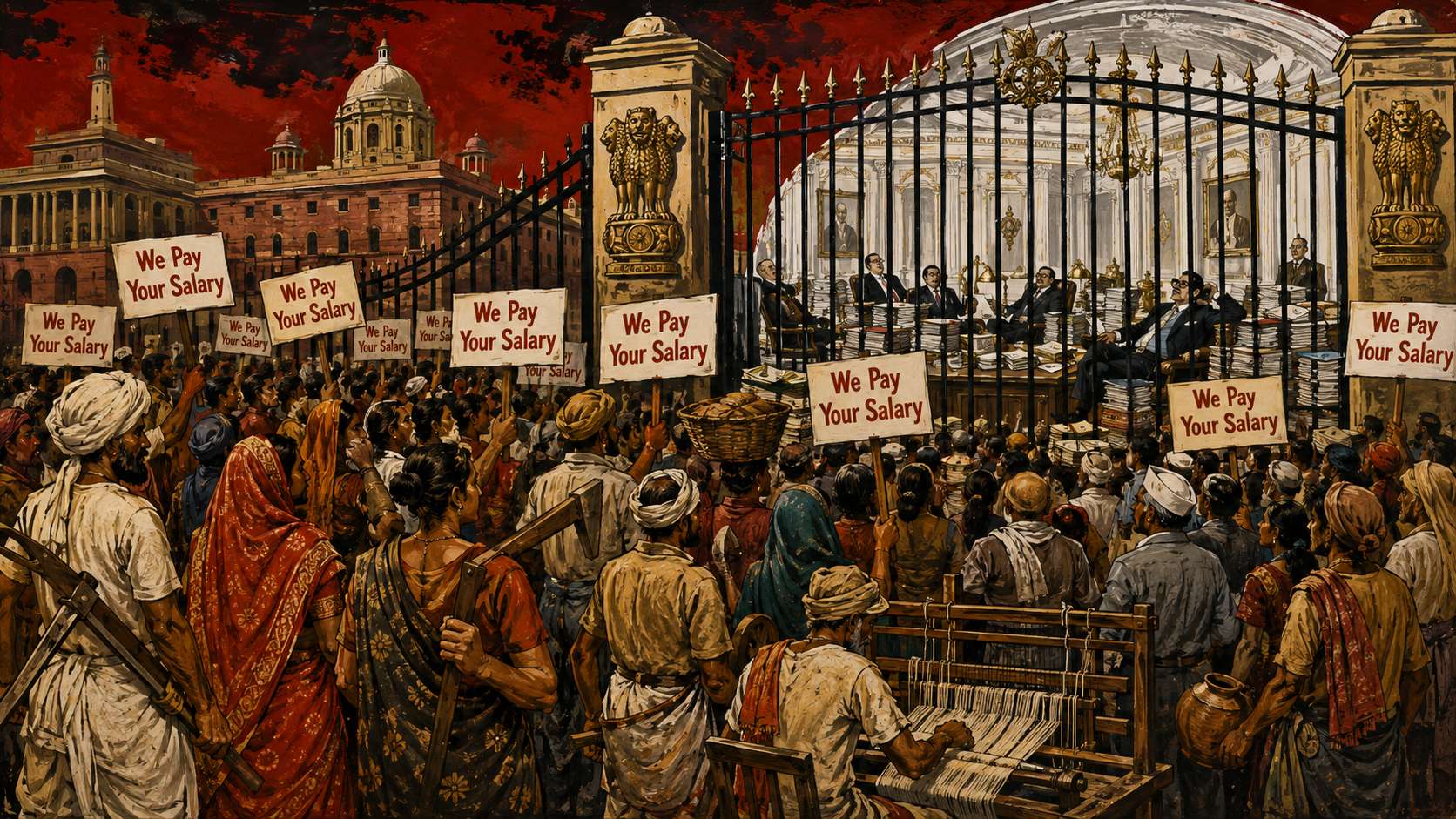
The first deception of the anti-reservation movement lies in language. They call the IAS, IPS, Revenue Service, judiciary, and senior civil services “government jobs.”
They are not jobs.
A software engineer writes code. A businessman builds a company. A doctor treats patients.
A bureaucrat governs.
He taxes citizens. He regulates industries. He controls police. He drafts policy. He acquires land. He decides licences. He interprets rules. He becomes the permanent face of the Republic long after elected governments have changed.
The Tahsildar who processes your land records is not performing a service. He is exercising sovereign authority over your property. The Collector who orders an acquisition is not doing a job. He is deploying state power over your life. The Secretary who drafts policy is not an employee. He is the permanent government — the one that survives every election, every change of minister, every democratic upheaval.
Reservation is not about employment. It is about who permanently exercises sovereign authority over the people of India.
And for 75 years, the answer has been: almost exclusively, a community that constitutes 15% of the population.
This is a democratic question. Not a historical one.
A democracy in which 85% of the population has no meaningful representation in the permanent apparatus of the state is not a democracy. It is an elected oligarchy — one that changes its ministers every five years while the actual machinery of governance remains, decade after decade, in the same hands.
Voting democratised political power. Reservation democratises administrative power. Without both, democracy is a performance.
Part Two: The Merit Fraud — Exposed by Its Own Believers
The Lie
The anti-reservation movement has one argument it returns to with religious devotion: merit. Examination scores. Competitive selection. The best candidate. Efficiency. Quality. It is their sacred principle. Their non-negotiable. The foundation upon which their entire moral case rests.
The Exposure: EWS — Self-Indictment on the Record
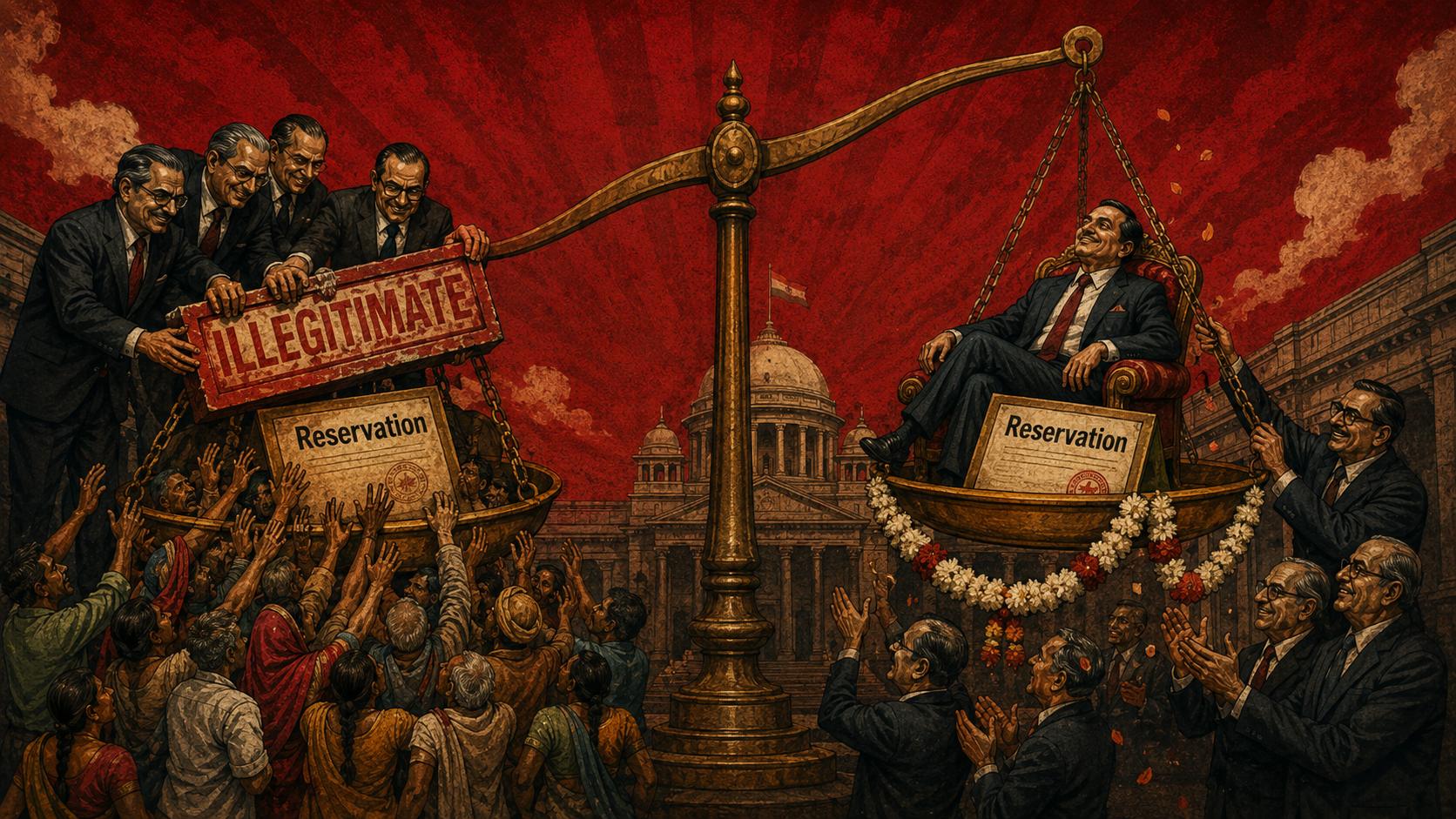
In 2019, the Indian Parliament passed the 103rd Constitutional Amendment, introducing 10% reservation exclusively for Economically Weaker Sections — defined in practice to benefit primarily upper-caste communities.
The same movement that had spent decades screaming that any reservation destroys merit, compromises efficiency, and insults the sanctity of competitive examination — fell silent. Then cheered.
Upper castes, who already occupy over 50% of entry-level civil service positions, who control over 95% of secretary-level positions, who have never in the history of independent India been underrepresented in any meaningful sense — were granted an additional 10% reservation.
And the defenders of merit said nothing.
Merit was never the principle. Merit was the excuse. The principle was always simpler: reservation for us is merit; reservation for them is compromise.
The 103rd Amendment did not just create a new category of reservation. It confessed everything.
The Merit Lie Collapses Further
If examination scores alone create the right to govern India, open UPSC to the world. Let the highest scorer become your Tahsildar. Your Collector. The officer who acquires your land, settles your disputes, commands your local police, looks you in the eye as the permanent face of state authority in your district.
If a Singaporean outscores every Indian candidate, let him govern your village. If a Japanese administrator tests higher, let him decide your land records.
Nobody will accept this. Nobody even considers it.
Because everyone instinctively understands what they refuse to say aloud: that the person with power over your land, your disputes, your local police must have some stake in your community. That legitimacy requires more than scores. That representation matters.
They accept this without question when the boundary is national. The moment the same principle is applied within India, the principle evaporates. This is not an oversight. It is a deliberate, conscious intellectual fraud.
The Freedom Struggle Argument They Cannot Answer
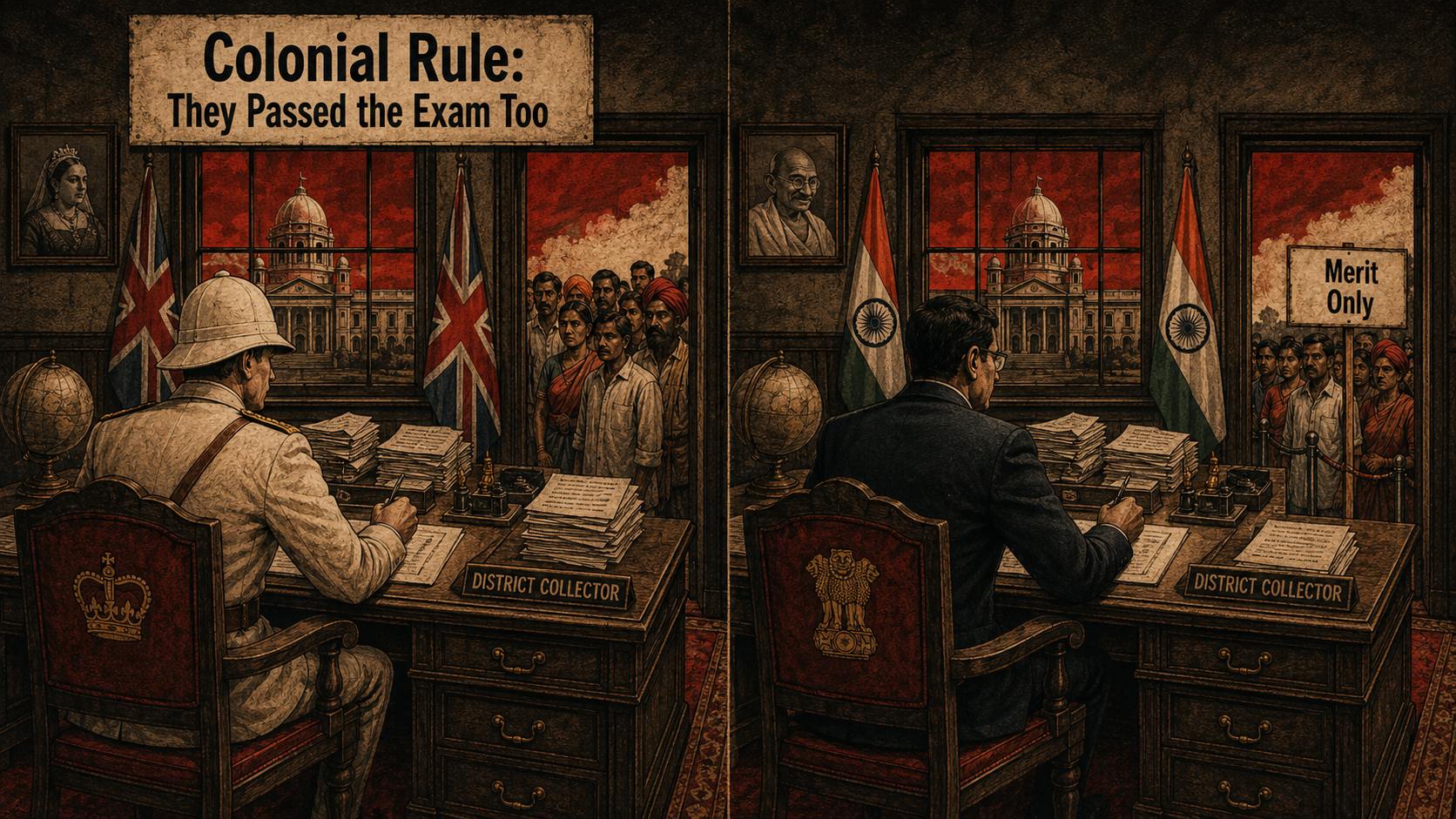
If merit alone — and not representation — was the legitimate basis for governance, why did we fight the British at all?
The British ran a meritocratic examination system. The Indian Civil Service had rigorous competitive tests. By the anti-reservation logic, a British Collector who outscored Indian candidates had every legitimate right to govern Indian districts.
But Indians did not die for the right to take better exams.
They died for the right to govern themselves. For the principle that sovereign power over a people must be accountable to and representative of that people — not merely technically competent over them.
The independence movement was a rejection of the idea that merit justifies alien rule. The anti-reservation movement has spent eighty years arguing the exact opposite — while wrapping itself in the flag of the very freedom struggle whose central argument it betrays.
What Merit Actually Requires
True merit in public administration is not the ability to memorize textbooks for a competitive examination. It is the capacity to govern. To administer a district of a million people from diverse communities. To understand ground-level reality. To exercise judgment under pressure. To command the trust of citizens who must submit to your authority.
A system that sources its administrators exclusively from a 15% social elite — insulated from the lived reality of 85% of the population they are meant to govern — does not produce merit. It produces a detached, self-referential bureaucracy that administers India for India’s upper castes, by India’s upper castes, with all the blindspots that entails.
Part Three: The Pyramid of Power
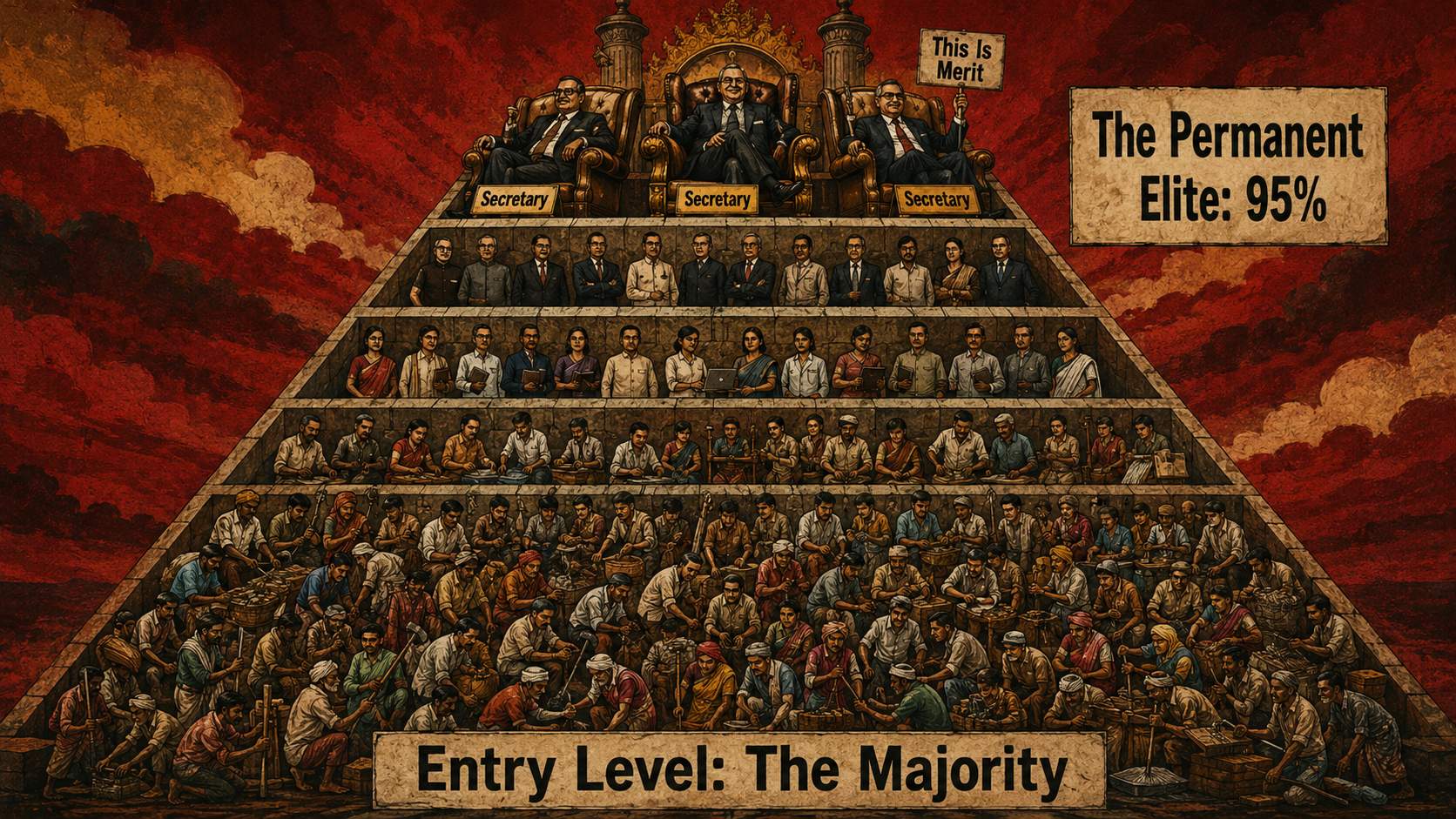
The anti-reservation movement claims that reservation has devastated upper-caste representation. Look at the actual data.
At the base of the civil service pyramid — entry-level positions, junior officers, lower bureaucracy — reserved category representation exists. Imperfect. Incomplete. Fought for over decades. But present.
As you climb the pyramid, something happens.
Joint Secretary: upper-caste dominance begins to reassert itself.
Additional Secretary: it consolidates.
Secretary and above: 95%+ upper caste.
This is not a natural distribution. This is a funnel.
It means that even where reservation has created entry points, the permanent machinery ensures that represented communities are filtered out as power increases. Junior officers from reserved categories exist. They do not reach the rooms where decisions are made.
The people who set policy for tribal welfare are overwhelmingly not tribal. The people who administer Dalit protection laws are overwhelmingly not Dalit. The people who govern OBC constituencies are overwhelmingly not OBC.
This is not a relic of history. This is the present configuration of the Indian state. And this is the system the anti-reservation movement exists to protect — calling it merit while resisting every attempt to measure it.
Part Four: The Creamy Layer Trap
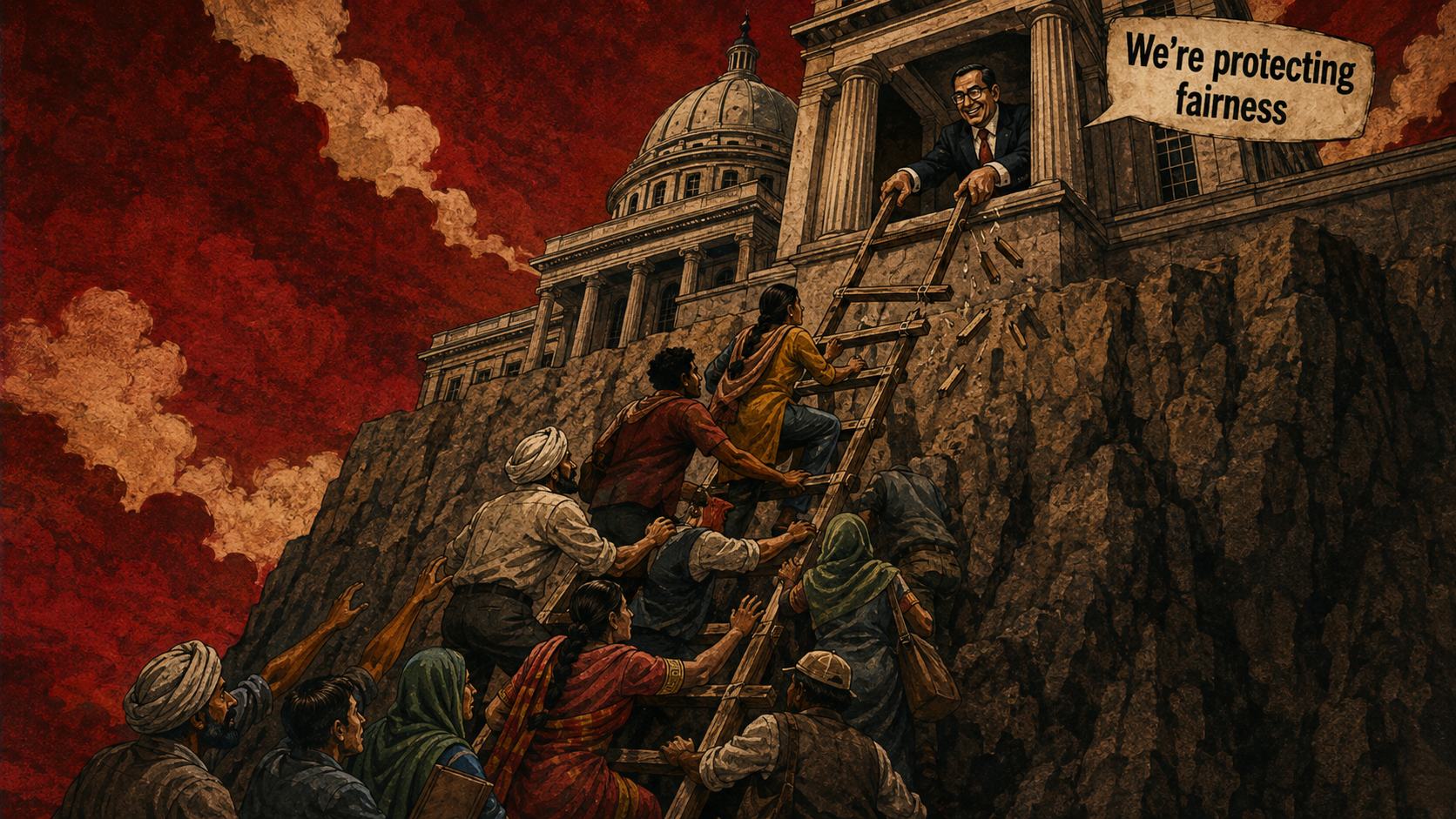
The creamy layer argument does not come from OBC communities. OBC communities have not asked for it. SC communities have not demanded it.
It is imposed on them — by the same people who oppose reservation — as a precision instrument to ensure that the most capable members of marginalised communities, the only ones actually positioned to reach the secretary level, are removed from the mechanism that would get them there.
After 75 years, 95% of secretary-level positions remain upper caste. And the argument now being advanced is that OBC and SC candidates who have succeeded enough to be competitive at that level should be excluded from the very protection designed to change this.
Reservation must never be allowed to reach high enough to actually change who holds power. That is the function of the creamy layer argument.
An OBC Collector does not hold the same power as a UC Secretary of Health. Removing the most capable OBC candidates from reservation does not help poorer OBCs. It simply guarantees the top remains permanently the same.
The creamy layer argument is not a reform proposal. It is a containment strategy — dressed in the language of fairness by the people it most benefits.
Part Five: The Brain Drain Fraud
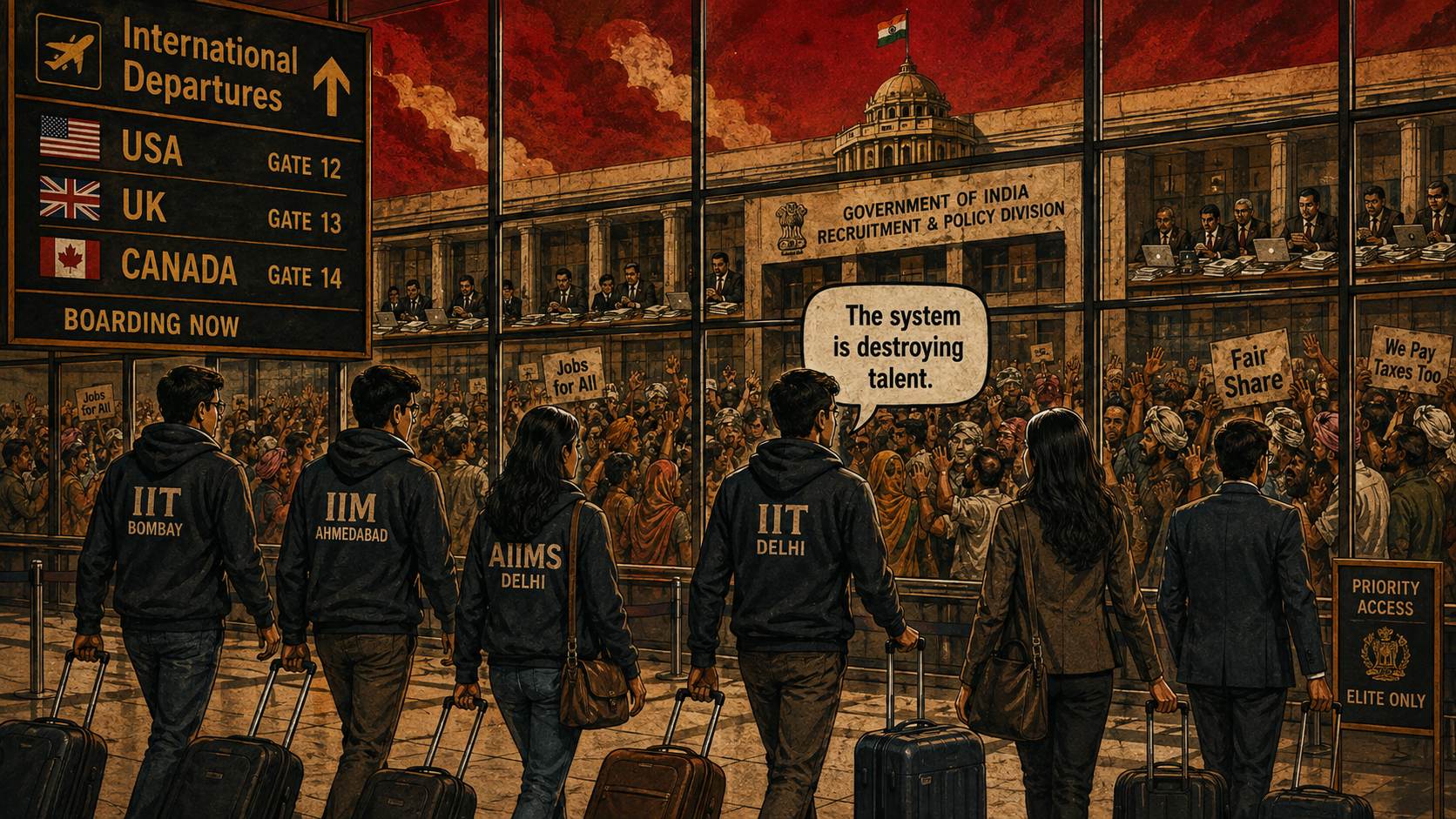
The anti-reservation movement loves the brain drain argument. Reservation drives away India’s best talent. The most capable people leave. The country loses its intellectual capital.
Let us examine who is actually leaving.
The children of upper-caste families — educated in India’s premier institutions, built and subsidised by the Indian state, beneficiaries of the institutional networks that generations of administrative monopoly helped construct — leave for the United States, the United Kingdom, Canada, and Australia. They do not return.
The actual brain drain is upper-caste, self-selected, and driven not by reservation but by the calculation that foreign economies offer better financial returns on social capital accumulated through India’s own public institutions.
And when they leave, they take with them the product of Indian public investment — the IITs, the IIMs, the medical colleges built on public money — while the communities who funded that public money through their taxes remain excluded from the institutions it was supposed to serve.
This is not brain drain. This is extraction. And the people who extracted feel entitled to call the remedy unjust.
Part Six: If You Won’t Share the State, Don’t Tax Us For It
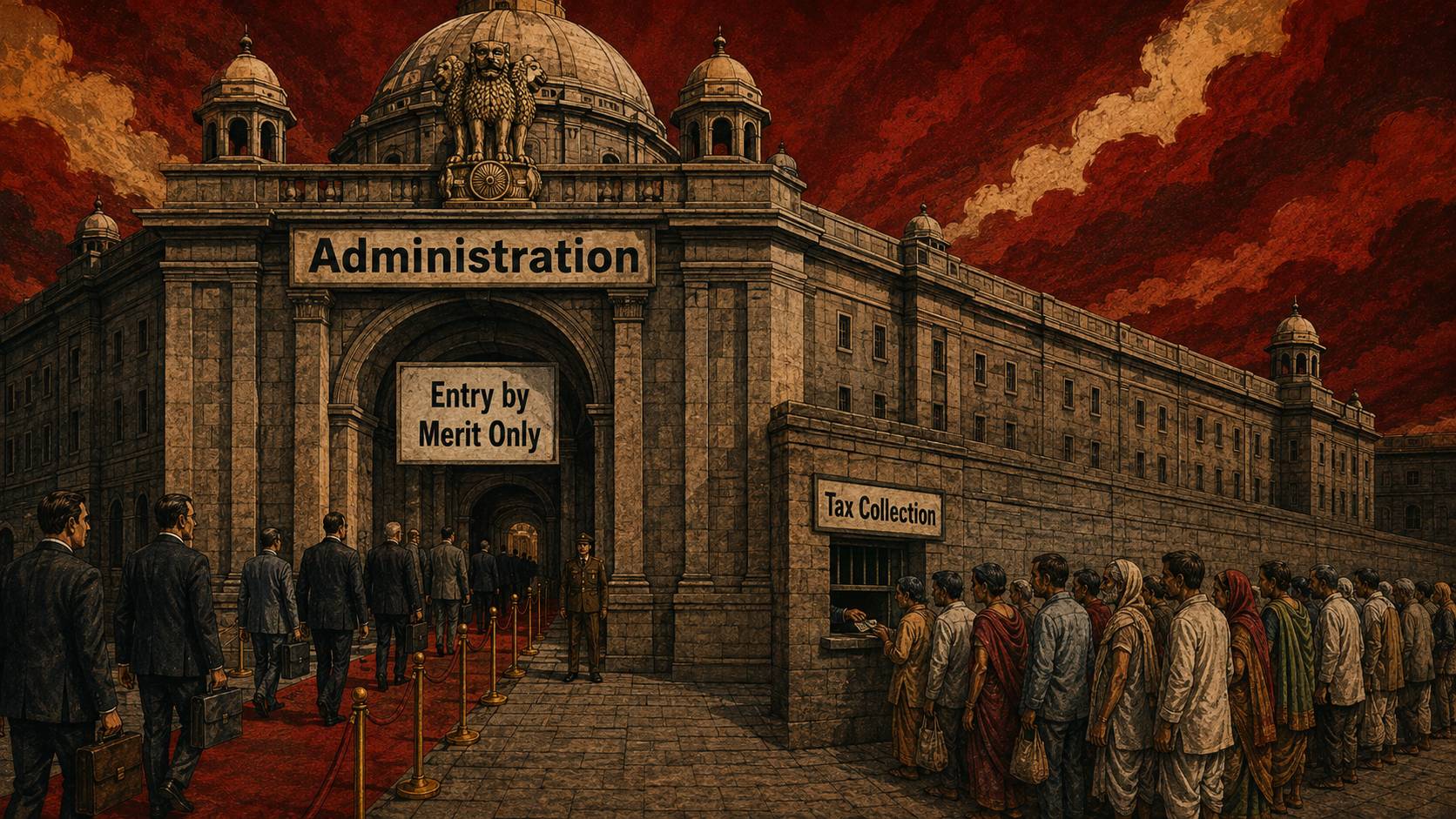
Here is the logical conclusion of the anti-reservation position, stated with complete clarity.
If upper-caste communities find it unconscionable to share the permanent machinery of the state with the 85% majority of Indians, then the solution is simple.
Let them govern themselves exclusively with taxes paid only by themselves. Let lower-caste communities collect their own taxes. Appoint their own officers. Run their own administration for their own affairs.
Watch how quickly the principle of unified meritocratic governance returns.
Because the anti-reservation position requires accepting something that has a name. It requires that a community be simultaneously obligated to fund the state, submit to the authority of the state, and be denied meaningful representation in the permanent machinery of that state.
The British did this. They called it the civilising mission. They too had examinations. Indians found another name for it. They called it colonial rule. They fought and died to end it.
The anti-reservation movement asks the 85% majority of Indians to accept a domestically operated version of the same arrangement. Same structure. Same logic. Same exclusion. Different accent.
Part Seven: The Caste Census — Why They Resist Counting
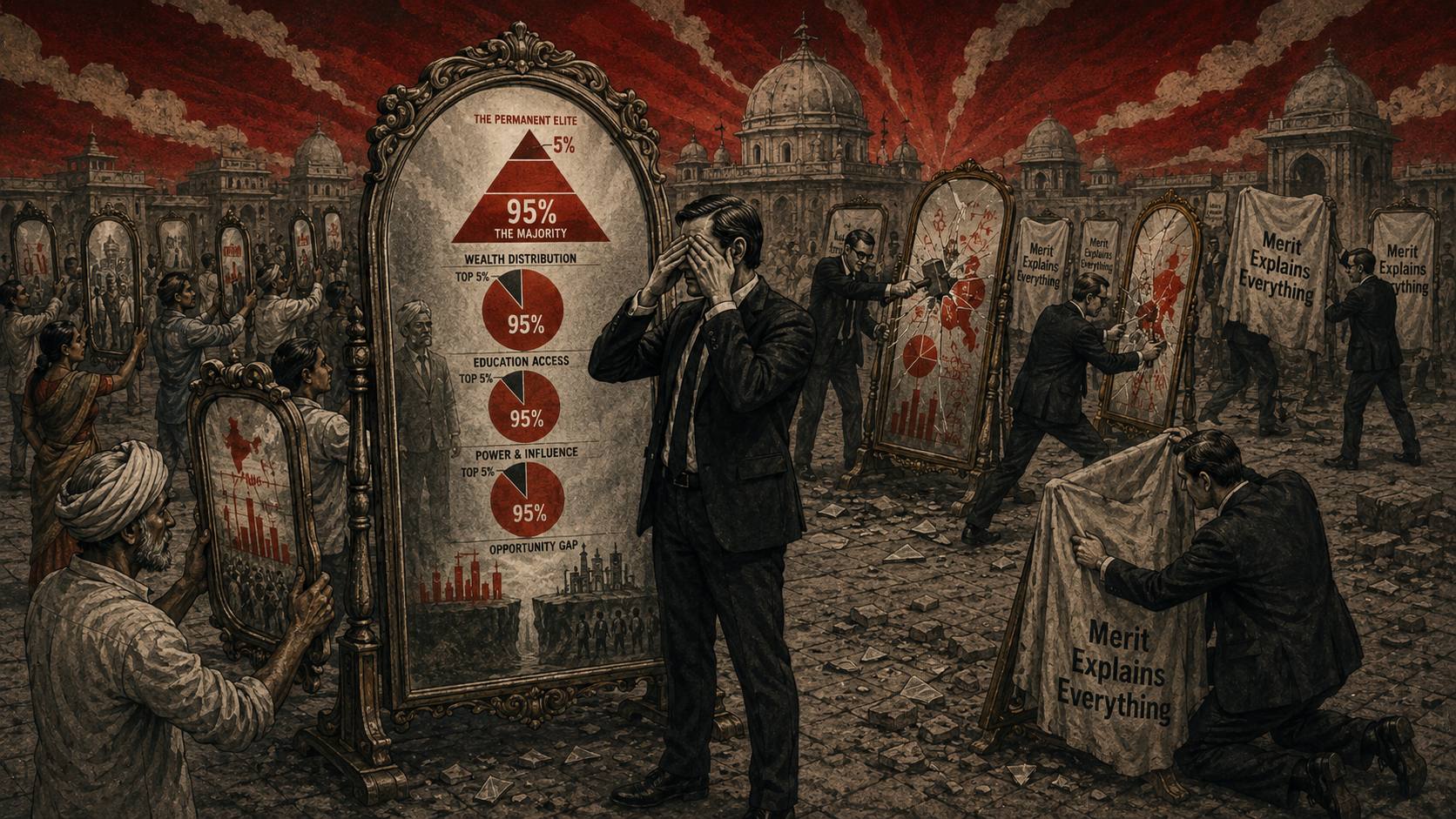
If the anti-reservation narrative were true — if reservation had genuinely devastated upper-caste representation, if merit truly explained the existing distribution of power — a caste census would be their greatest weapon. The data would vindicate 80 years of argument. They would demand it.
Instead, they resist it with every instrument available.
This is not a minor inconsistency. It is a confession.
It means they know — they have always known — that the data would show exactly what the pyramid of power already suggests: that the permanent Indian state remains, despite reservation, overwhelmingly in the hands of 15% of the population. That the merit argument, subjected to actual measurement, would collapse.
The merit argument survives only in the darkness. It cannot survive contact with evidence. Movements confident in their facts welcome measurement. Movements built on mythology resist it.
Part Eight: The Population Proportionate Challenge
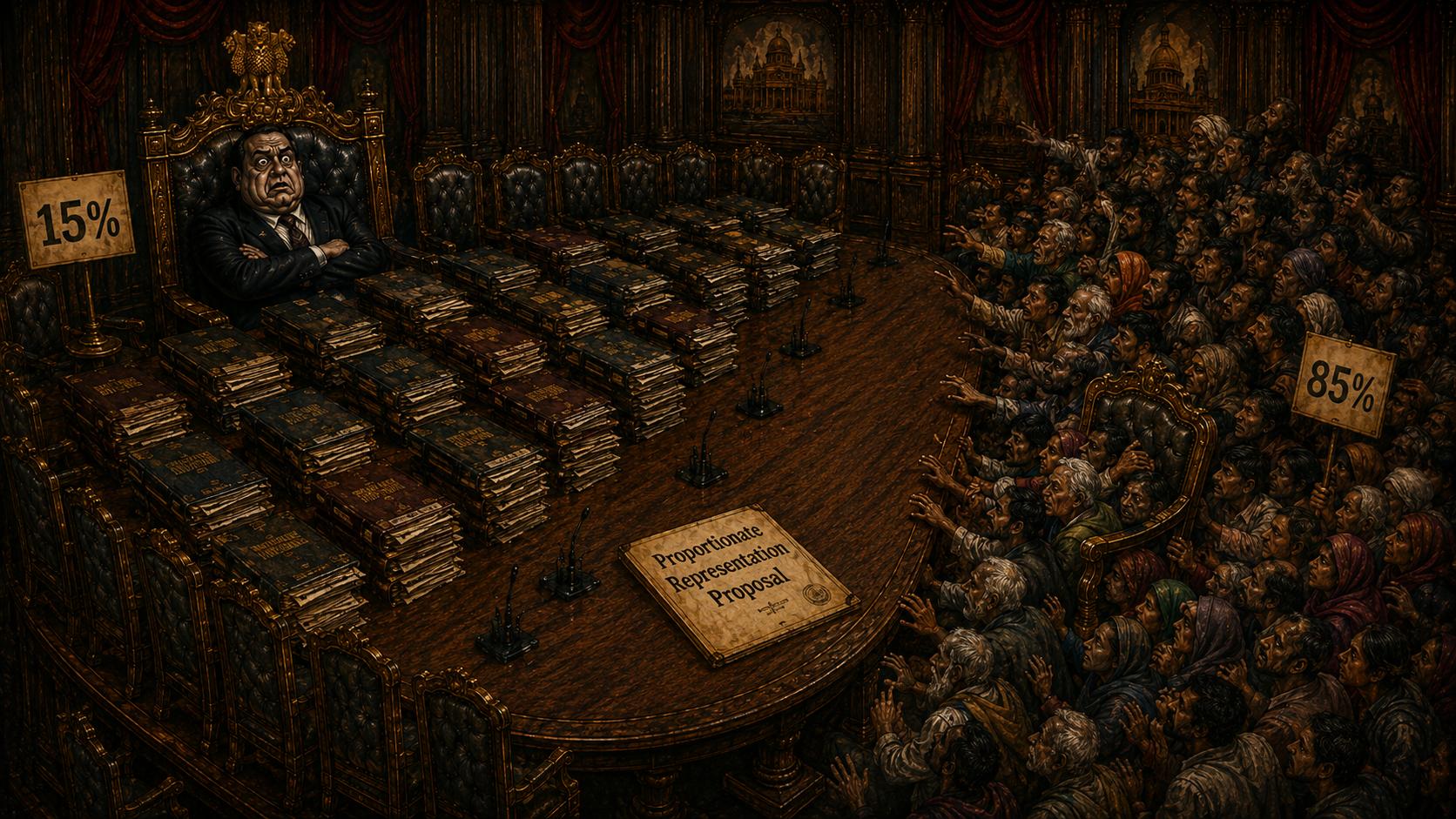
Here is an offer that should be made clearly and on the record.
If the anti-reservation movement genuinely believes in fair representation — if the objection is truly to the current system’s imperfections rather than to representation itself — then accept population-proportionate reservation.
85% representation in the permanent state. Proportionate to population. No more, no less. Not as a demand. As a test.
If the response is outrage — if proportionate representation of 85% of India in the state that governs 85% of India is considered an attack on merit — then the argument is over.
It proves that the objection was never to imperfect reservation. It was always to any meaningful representation at all. It was always about protecting 15%’s control over 100% of the permanent state.
Part Nine: The Sangathan Lie
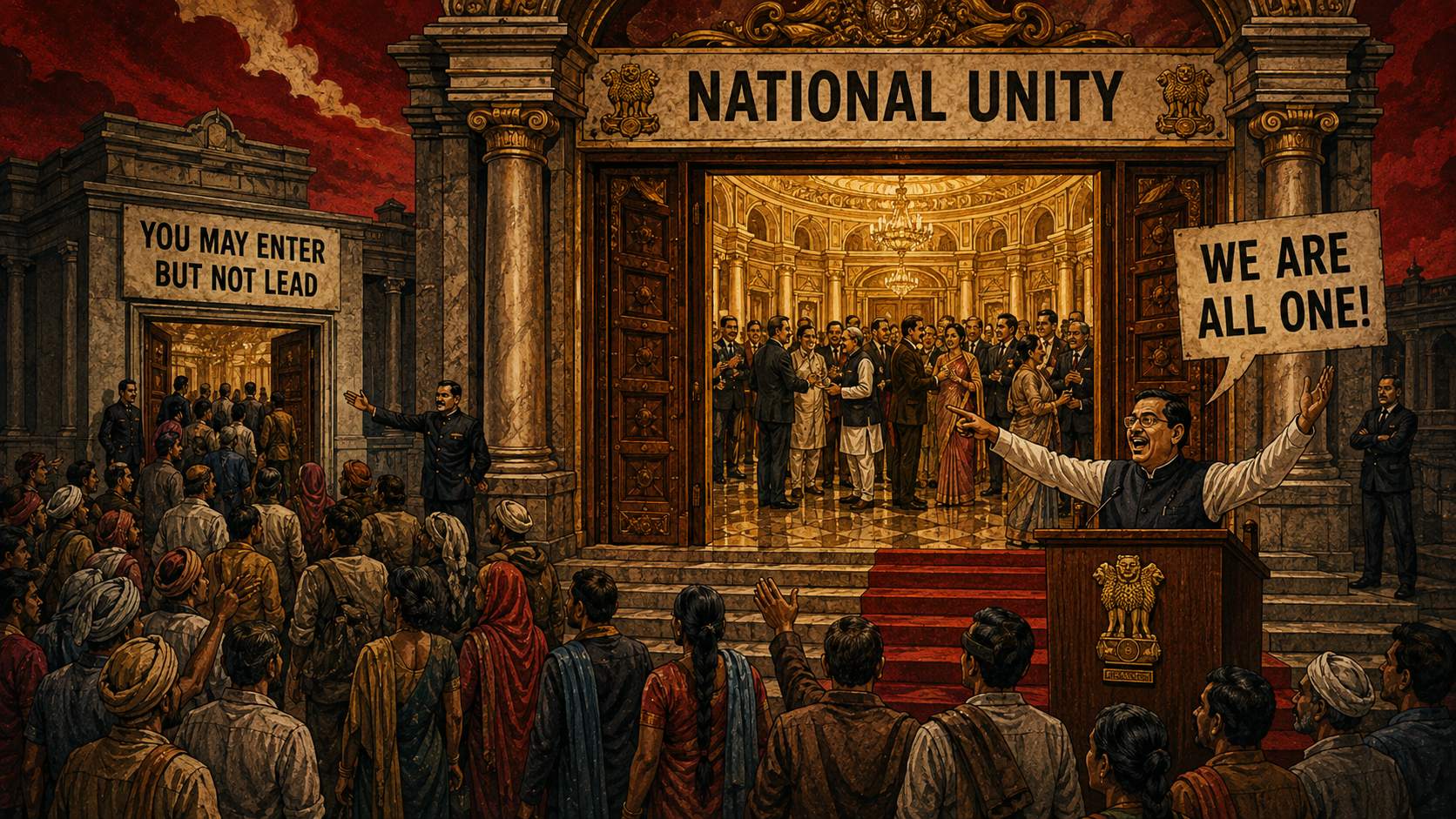
The anti-reservation movement frequently invokes Hindu unity. Sangathan. The idea that Hindus must stand together, present a unified face, build a consolidated social and political force.
It is a remarkable argument to make while simultaneously demanding that 85% of Hindus remain servants in their own Republic.
You cannot preach Sangathan while operating a system that ensures SC, ST, and OBC communities are filtered out of power as they rise.
Sangathan requires that all participants have an equal stake in the shared enterprise. A community that is taxed, governed, and administered but not represented in the machinery of governance does not have a stake. It has a burden.
The anti-reservation movement does not want Sangathan. It wants compliance dressed as unity.
True Hindu unity — true Indian unity — is impossible without meaningful representation of all communities in the institutions that exercise power over all communities.
Part Ten: The Myths, Demolished
Myth One: Reservation Kills Merit and Ruins Governance
The argument that reservation has degraded India’s bureaucracy requires answering one question: What was the quality of governance when the bureaucracy was an exclusive upper-caste monopoly?
India’s administrative failures — red tape, corruption, policy paralysis, poor infrastructure execution, institutional rot — exist across the entire civil service regardless of quota. These failures are structural, caused by weak accountability systems, political interference, and incentive structures that reward compliance over performance.
If that monopoly guaranteed quality governance, India would have possessed a corruption-free, high-performing administration long before reservation existed. It did not. The failure was structural. The scapegoat was convenient.
Myth Two: Economic Criteria Should Replace Caste
Poverty is a financial condition. Caste is a structural social and political reality. More critically: if reservation were shifted to pure economic criteria, upper-caste communities — who face poverty too — would immediately qualify in large numbers. The 95% secretary-level domination would not change by a single appointment.
Economic criteria reservation is not a reform proposal. It is a mechanism to eliminate community-based representation while maintaining community-based outcomes — and calling it fairness.
Myth Three: Reservation Creates Division
The argument that inclusion causes division — that demanding representation creates conflict while demanding exclusion promotes harmony — is not a political argument. It is an instruction to be quiet.
True social harmony is impossible when 85% of a population funds and submits to a state apparatus controlled almost entirely by the other 15%. That is not harmony. That is a managed inequality that persists only as long as the majority accepts its own exclusion.
Myth Four: Why Should Current Generations Pay for Historical Injustice?
They shouldn’t. And this essay does not ask them to.
This argument is about today’s democratic deficit — not yesterday’s moral crimes. The question is simple and present tense: Is it democratically legitimate for 15% of India’s population to permanently occupy 95% of the commanding heights of the state that governs all of India?
If the answer is no — and in any serious definition of democracy, it is no — then the remedy is not punishment of anyone. It is correction of a present imbalance.
Epilogue: The Choice Before India
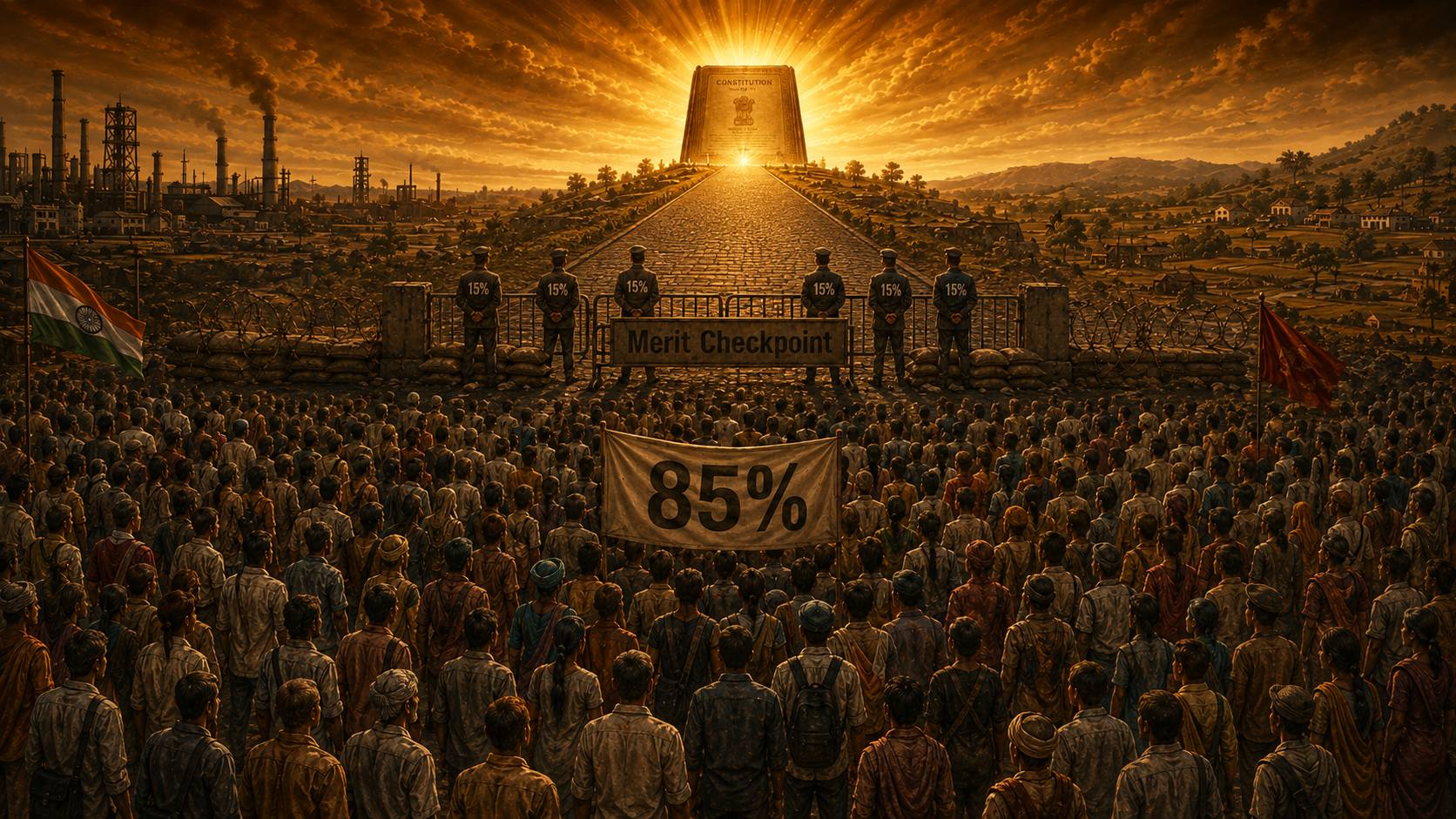
India must ultimately choose between two visions of the Republic.
One holds that the permanent state is a technocratic institution whose legitimacy flows from competitive examinations — examinations whose design and cultural assumptions it declines to examine, producing a distribution of power it insists is pure and calls merit.
The other holds that the permanent state is an institution of democratic authority whose legitimacy depends not only on competence but on meaningful participation by the society it governs — that a state which taxes and governs all of India must, to be legitimate, reflect all of India.
This is not a debate about the past. It is a debate about what democracy means.
The anti-reservation movement welcomed EWS reservation for itself while calling reservation for others a constitutional disaster. It resists the census that would prove its claims while making the claims. It preaches Sangathan while defending the pyramid that makes Sangathan impossible. It talks of brain drain while its own children drain themselves to foreign economies on Indian public investment.
The freedom struggle was not fought so that alien rule could be replaced by domestic minority rule wearing a democratic mask. It was fought so that India’s people could govern India. All of them.
The population proportionate offer stands. 85% representation for 85% of India’s population.
If that is unacceptable, then nothing was ever about merit, efficiency, or the quality of governance.
It was always about power.
And it is time India’s majority said so — clearly, loudly, and without apology.